Overview
Engine: LORE [Proprietary]
Tools: Adobe XD, Atlassian Suite, Custom Proprietary Tooling
Full-Team Size: ~250
Strike Team Size: ~15
Design Team Size: ~3-4
Role: Mid-Level Systems Designer (4.5 Years Industry Experience)
Duration: Aug. 2022 - Dec. 2022
I joined the Civilization team while working at Behaviour Interactive in the Studios (External Contracting) division. As part of our mandate, we were to help Firaxis bring the vision of Civ 7 to life on console platforms. A major component of this was trying to make the UI accessible to an entirely different control schema than mouse and keyboard. Separately, during the production of the project, the Lead Designer departed, which provided opportunity to contribute by completing a design for the Trade-Route system in the game. These elements were completed while simultaneously onboarding a junior designer, which involved reviewing, critiquing, and helping them to prepare to present their work to directors, and co-dev stakeholders.
Please note: Due to the nature of co-dev work at the time, I was unable to retain access to my work and documentation as we did not receive permission from the client to do so. Therefore, any media shown is representative of the final iterations of content visible in the final product, and not necessarily reflective of its state at the time I worked and contributed to it.
My work on the project:
Radial Menu
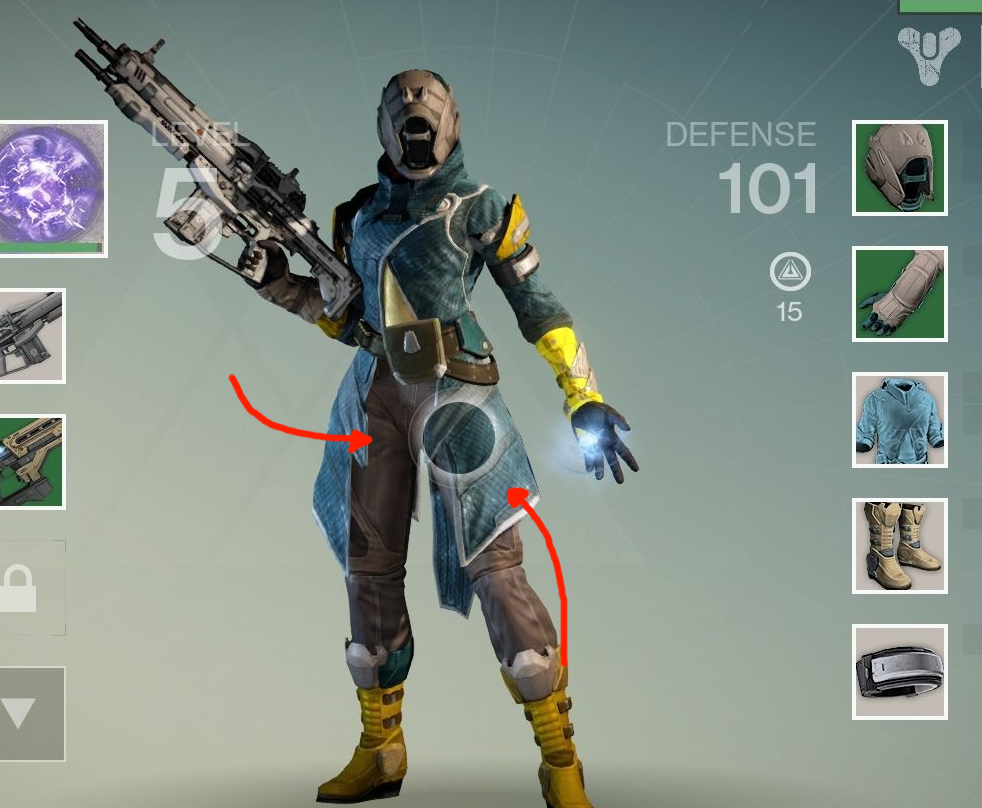
Cursors controlled by console sticks were frequent appearances in other similar budget titles.
Image Credit: “Soapbox: Can we Please Kill Cursors in Console Games?”
Cursors controlled by console sticks were frequent appearances in other similar budget titles.
Image Credit: GameUIDatabase.com
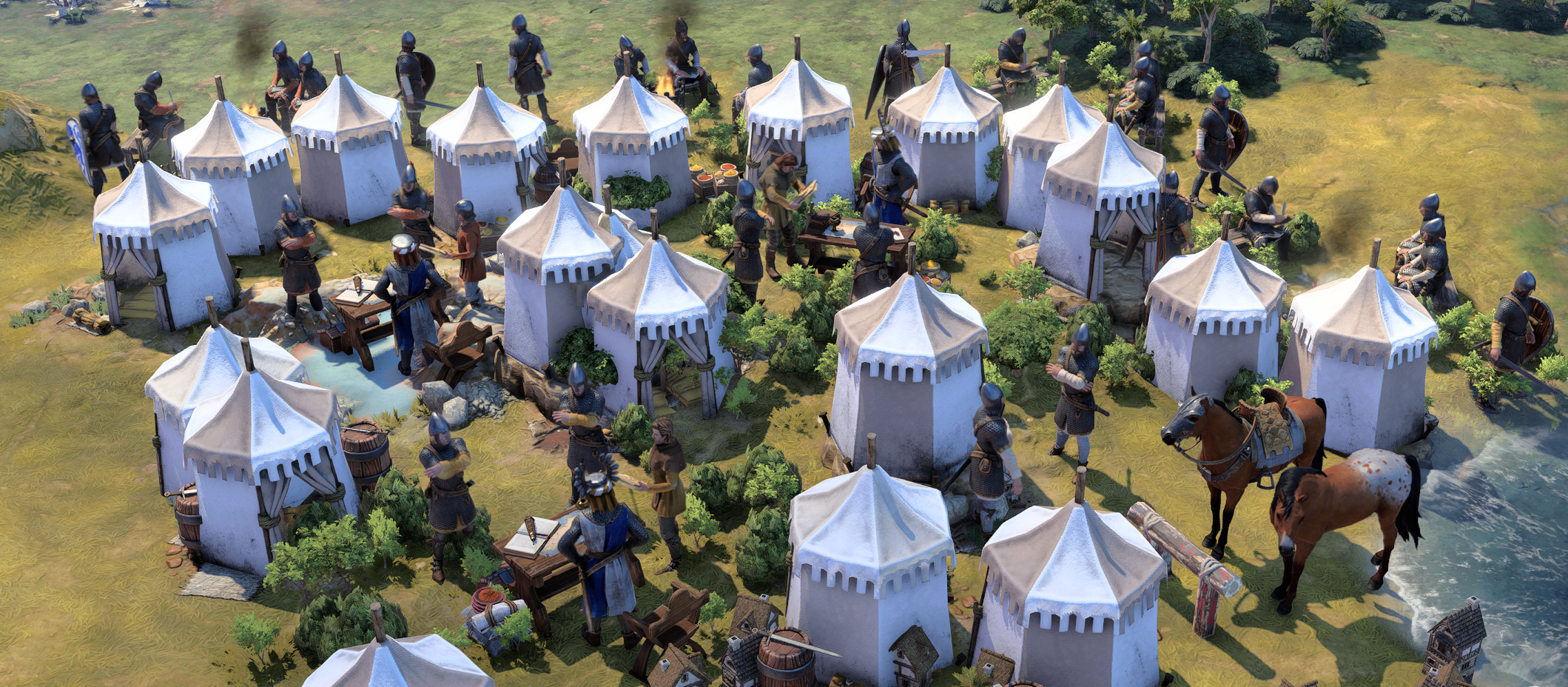
Cycling through this many units on a precise radial wheel was an unreasonable ask I wasn’t prepared to force my players to face.
The Radial Menu was the ideal solution to iterate on which would contain the complicated nested menus CIV is known for.
Context
Imagine trying to read a massive, sprawling historical encyclopedia from ten feet away on your couch, but instead of turning pages, you’re forced to use a shaky arcade claw-machine crane to point at the exact paragraph you want. Every time your hand twitches, the crane swings, clips an edge, and accidentally shuts the book. It’s infuriating. Now imagine that exact same UI nightmare, but layered over a complex world map where thousands of years of human history hang in the balance.
Civilization VII is a titan of information, a 4X heavyweight that requires players to climb mountains of data to make smart, empire-defining decisions. Historically, the standard fix for console ports has been a "virtual cursor" which turns the thumbstick into a makeshift mouse substitute. But 4X maps are densely packed with information, and constantly shifting. Thumbstick drift or a single centimeter of over-correction can cause the cursor to miss collision boxes, triggering accidental interactions with elements you can't even see.
This was the biggest challenge in trying to bring the vision of Civilization VII to console platforms.
Approach
I set out to tackle this problem with an underlying mantra: console games should feel like they were actually made for that console. We shouldn’t seek to drag keyboard and mouse expectations kicking and screaming onto a platform where they don't belong. The pursuit of deep strategic play, on a couch, should minimize as much menu friction as can be mustered.
My starting point, which quickly became my working internal model, was found not far from home. In 2013, Firaxis released The Bureau: XCOM Declassified, a tactical third-person shooter spin-off from the main XCOM franchise. While it received its fair share of mixed reviews upon release, it did tackle one design challenge that felt strangely familiar: how do you bring complex, nested tactical data to the forefront of a controller without breaking the player's flow? Their answer was a radial menu. With this lead in mind, I set to identify the full scope of how a wheel could handle the sheer, terrifying data density of a Civilization game.
Scope
With the working model clear in my mind, the next challenge was defining what actually belonged on the wheel and what needed to be aggressively kicked off it. A standard radial menu works beautifully when you break a 360-degree space into comfortable 20 to 30 degree sections. In the early game, when a player only has a handful of scouts and warriors, mapping units to a wheel is a spatially easy. But Civilization games scale massively. By the late game, a player's military roster easily balloons to 40 or 50.
Industry UI standards show that precise articulation becomes a nightmare once a radial menu goes past 8 to 12 slots; trying to jam 50 units into sub-10-degree slivers makes selection mechanically frustrating on a standard controller. It turns high-level strategy into a game of Operation which I didn’t think 2K or Firaxis would be pleased with. To solve this, I pulled units out of the radial layer entirely and offloaded them to dedicated bumper buttons for rapid cycling.
That left the massive, permanent systems like cultural policies and the science tree to occupy the core slots where they could be accessed quickly and frequently.
Diplomacy became the next wild card. With a massive roster of world leaders and iterations from CIV VI trying to evolve diplomacy into a more complex system, nesting foreign relations inside an already busy empire wheel felt like a recipe for a messy interface. Instead of burying it, I split diplomacy onto its own dedicated context wheel. One button press brought up your internal empire; a different button press brought up the world stage.
Result
The final layout successfully established the foundational menu navigation framework for the console release of Civilization VII. By filtering out dynamic units and separating empire management from diplomacy into dedicated, context-specific wheels, the design proved that a dense 4X interface can achieve clean, easy inputs on a controller. It eliminated the frustrating precision requirements of a virtual cursor, ensuring console players could access deep, multi-layered data tabs with simple thumbstick flicks.
Index
Please note: Due to the nature of co-dev work at the time, I was unable to retain access to my work and documentation as we did not receive permission from the client to do so. Therefore, any media shown is representative of the final iterations of content visible in the final product, and not necessarily reflective of its state at the time I worked and contributed to it.
Trade Routes
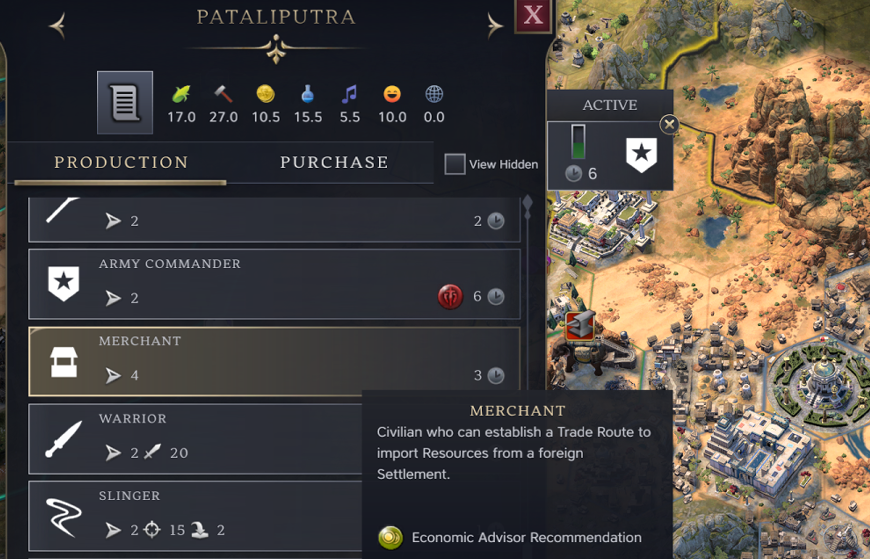
Entry into the trade system starts with construction of a Merchant from the City production menu
Image Credit: Gamespot: “Civilization 7, how merchants and trade routes work”

The players resource bar is near the front of their minds during most turns of Civilization
Image Credit: “IGN: 14 Civ 7 Mistakes to Avoid”
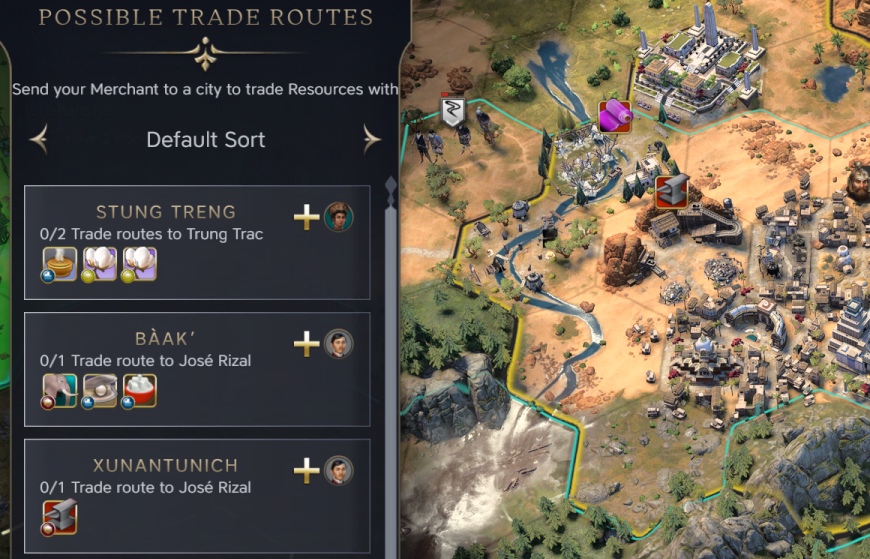
Selecting the Trade Route most desired is a complicated and cumbersome decision which has long-lasting consequences for your gameplay.
Image Credit: Gamespot: “Civilization 7, how merchants and trade routes work”
Context & Mandate
Value in a 4X strategy game is a constantly moving target. What looks like an economic jackpot on turn 10 can become a massive liability by turn 100, and managing that volatile reality was the core puzzle of the Trade Route system. Mid-production, the project's Lead Designer at Firaxis, David McDonough, departed the studio. This left a critical design gap on the feature, and created an opportunity for me to step in and drive the design forward.
At that moment, conceptual work on Trade Routes was still in its infancy, and the project was targeting a massive multi-platform milestone: launching Civilization VII on PC and consoles simultaneously. Civilization VI had maintained a high bar across the series with an elegant economic UI that players grasped with minimal frustration. The mandate for my contract was to define exactly what critical data needs to scream at the player from the surface, and what needs to stay quietly tucked away until called upon.
Approach
The core of my approach was prioritizing representing dynamic yield over static filters. When players open the trade screen, the most important thing they care about is making their best possible deal. Instead of forcing players to dig through menus populated by static lists, like a route strictly showing 30 gold per turn versus another showing 14 gold per turn, I designed the view to dynamically highlight the highest-yield justification for choosing that specific route. That 30 gold per turn route might be nice when filtering by Gold, but that 14 gold per turn route could also have a whopping 19 food per turn, arguably a higher value to the players.
In a 4X economy, value is entirely contextual. A player facing a food deficit, or chasing a cultural victory, doesn't care ONLY about a flat gold sort. Sorting strictly by a single raw number forces the player to open multiple sub-menus to calculate the trade-off. The design needed to calculate and surface the dynamic 'why' upfront, matching the route's output directly to the immediate strategic benefits of the empire without making the player hunt for it.
The simultaneous PC and Console release mandated an androgynous, forward-thinking UI. I was very conscious about ending up in a pipeline trap where we designed a great PC interface, only to have to quietly rebuild a secondary, constrained version for consoles later. The solution was to anchor the design in the fundamental control schema we had already established for consoles, but scale it so that PC players still had immediate access to all the granular information they expected from a Civilization title.
Result
The initial pitch immediately went into the iteration grinder. Upon delivering the concept to the Firaxis UI team, the structural core of the proposal survived, but a significant portion of the surface display choices were stripped back. Project leadership saw the clear merit in the system, but they were not ready to prioritize a trade-route overview screen as a need at that point. I packaged the proposal, documented everything on their Confluence and handed it off to their internal UI/UX team to use as a baseline for the time they were ready to come back to it. Ultimately, the shipping version of Civilization VII chose to bypass a dedicated trade-route overview screen entirely.
It's a completely valid question to ask why a feature that hit the cutting room floor deserves a spot in a systems design portfolio. The reality of the industry is that your scrapped ideas teach you just as much as your wins. It teaches you how to step into an external production, quickly integrate with an established team, iterate under multi-platform constraints, and hand off documentation. To see how I evolved as a Designer with these lessons, please check out my work with my next project, Rainbow Six Magnum(password required).